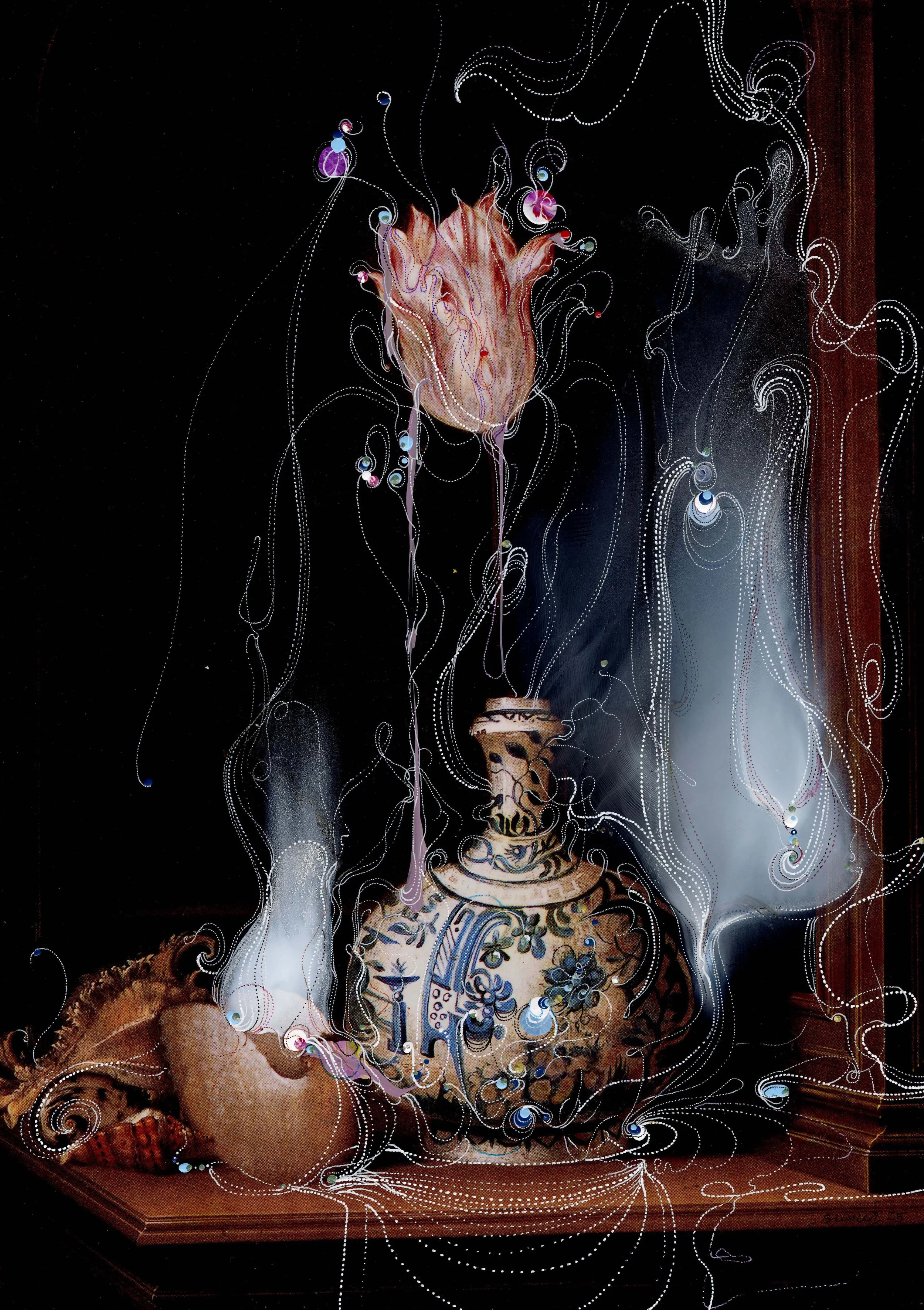
Sebastiaan Bremer - Super Modern Things

by Sebastiaan Bremer, Julie Castellano, Christian Viveros-Fauné

Graphic design by Mart. Warmerdam

99 Publishers, Haarlem, 2026. Hardcover.

For more information or to purchase the book please visit 99 Publishers.

Excerpt below:

First to Fall: Sebastiaan Bremer’s Flower Paintings

They called me the hyacinth girl.

—T.S. Eliot, The Waste Land


Flowers are universally recognized as harbingers of spring. In New York, they appear mostly as varietals around city parks but also as a seasonal display of 60,000 tulip blooms on Park Avenue, from 54th to 86th Streets, between April and May of each year. Asia’s biggest flower garden flourishes during the month of March, courtesy of the Srinagar Tulip Festival in Kashmir, India—as many as 74 acres of land overflow with multihued beds, water fountains and manicured walkways. In The Netherlands, where 80% of the world’s tulip bulbs are grown, spring sees the efflorescence of upwards of 7 million tulips in agricultural fields across the land, resulting in a riotous mixture of color and commerce, short-lived beauty and centuries-old floriculture.

When you hear the word “tulip,” The Netherlands and Dutch painting invariably come to mind. This is partly due to a long tradition of still life flower painting that helped give shape to that country’s Golden Age—one that stretches across centuries of European art and, unsurprisingly, shows no sign of abating today. This artistic inheritance, an enduring devotion to petaled likenesses, constitutes a veritable Kew Gardens of floral imagery. Among its most original and weirder examples are drawings, paintings, photographs and sculptures by artists as varied—and variously motivated—as Jan Brueghel the Elder, Jacob Vosmaer, Jean León-Gérome, Vincent van Gogh, Georgia O’Keefe and Jeff Koons.

The most recent additions to this vast florilegium are the sparkling yet melancholy paintings of Sebastiaan Bremer. A turmoil of tulips, azaleas, daffodils, roses, camelias, carnations, chrysanthemums, irises, anemone, narcissi, rhododendrons, and cactus flowers, they plumb and push forward the Netherlandish tradition while carrying on a profound conversation with art history past and present. To complicate—or, better put, concentrate, matters— Bremer paints neither on canvas nor on copper, as Ambrosius Bosschaert the Elder did when executing his pearlescent Bouquet of Flowers in a Stone Niche (1618). He does so, instead, on existing photographic prints, like later photo-spiritists William H. Mumler, Hans Bellmer and Duane Michals.

Bremer is nothing if not manic about his intense work rate and evolving bouquet of cascading associations. In more than one hundred related compositions, dilated flowers appear as the ultimate archetype—think Sunday parkgoers tracing shapes, objects and faces in cottony cloud formations. The artist’s retouched flora both discomfits and accommodates, a function of his carefully placed pointillist marks, stains and blurs, which also outline an eccentric expansiveness of vision. Bremer’s manipulations of modest-sized snapshots—many of his photographic supports measure just 11x 8 inches or smaller—don’t just challenge contemporary orthodoxies of scale, they zoom in and out like eyes adjusting to brand-new contact lenses. Together, his singular flower worlds contain whorled universes: there’s the personal and the political, the historical and the immediate, the worldly and the psychological, in ways that alternately frighten and fascinate. 

If the widespread popularity of flowers, especially tulips, turns their forms into a repeating motif for an artist like Bremer, this is owed, in part, to their Rorschach blot allusiveness. Long used as a memento mori by artists—that is, as a reliable symbol for life and death—their familiar shapes foment sympathies that could be termed Stygian: an invocation of nature’s transitory middle passage, which the artist describes as connected to “sickness, reflecting joy and sorrow in beauty and fragility.” Bremer is in excellent company here. Consider Jan van Huysum’s painting of sprays of drooping, water wicked Flowers in a Terracotta Vase (1730); or Hans Bollinger’s Floral Still Life (1639), an exuberant mass of tulips, anemones, roses and carnations that only bloom together in the supreme fiction that is his picture. A third painting by Hendrik Gerritsz. Pot, Wagon of Fools (1637), presents a related allegory of a different sort. A satirical glimpse into the madness that motivated the world’s first financial bubble, it depicts beauty’s commodified dark side during the mass insanity that was the Tulip Craze. In Pot’s famous oil on panel parable a group of Haarlem weavers chase a wind-borne wagon flying alabaster tulips and a fool’s cap straight into the sea. (Bollinger, too, it bears mentioning, painted his still life shortly after the speculative market for tulips crashed the same year.)

A fashioner of intimist pictures, Bremer also knows to connect the inherent seductiveness of his flower-scapes to the eternal folly of market instrumentalization; that, and our current madness for everything from crypto to neofascism to the dangers, real and imagined, of The Singularity. As he sagely puts it, there exist, in every age—though clearly in some way more than others—“intricate connections between joy and beauty, greed and decay.” Despite their stunning good looks—one particularly fetching arrangement in dotted and stained inks called Literally and Figuratively (2026) recalls Jacob Elordi’s frame filling a movie screen—Bremer’s artworks reach backwards to contemporize the present, while acknowledging, exploiting even, the cargo hold beauty creates to smuggle inconvenient truths. This explains, at least in part, why the artist considered christening his 21st century vision of flower power “Sinnepoppen”. An erstwhile, now masked, reference to Roemer Visscher’s 1614 volume of illustrated parables—the English translation of the original title is “dolls” or “figures for the mind”—his previous appellation cites a once wildly popular Dutch book; one that trafficked in 196 engravings and as many cautionary tales. Its subtitle: “Wise lessons about the pursuit of wealth.”

Bremer’s final title for his larger project is “Super Modern Things,” a phrase he admits cribbing from Vladimir Nabokov. (He also readily admits to lifting titles of individual works from authors like Benjamin Labatut; he finds them, he says, while reading in the bath). It’s a significant Dutch understatement, an onderschatting, to say that Bremer’s current pegpartakes of a certain knowing irony, while, additionally, implying exhaustion with the ways of man and the world. (In a note the artist expressed the idea that the term “modern” hardly means modern anymore—“postmodern, contemporary and ultra-modern don’t work either”—adding that “the way we manipulate nature,” flowers, for instance, is “old news” since humans have deployed “the same tricks since the beginning of time.”) But Bremer’s flower paintings do more than share their creator’s world-weariness—they allegorize it revealingly, à la Bollinger, Visscher and Pot. Consider, for instance, works like Frivolous and Deceptive Patter (2025) and Solid Tenderness (2025). The first interlaces skeins of multicolored acrylic dots along with purple, yellow, blue and chartreuse ink washes atop a C-print of a page taken from a postwar reproduction of a 17th century tulip book—the kind wealthy traders once commissioned from leading Dutch artists to list (and advertise) their inventory. The second, a similar composition in darker swirls, ghosts the same printed image of a flower from crown to stem. A rare and expensive tulip of the sort that nearly sunk the Dutch economy, it circles the plant’s vertical axis like a ring of regrets while spelling out the following message: “Brutality Stupidity Noise.”

To cite copy from Bremer’s Amsterdam gallery, Galerie Ron Mandos, the previous two works—along with earlier, similarly lush but less complex flower pictures, such as Spring (2013), Breeder Tulip Indian Chief (2016) and Tulipa for Sverner (2018)—belong to an evolving batch of “hand painted interventions and markings on photoprints made from a Dutch photography book titled Bloemen.” Compiled by horticulturalists Johan Frederick Christiaan Dix and Walter Roozen as an act of cultural resistance during the German occupation, Bloemen constituted, according to the gallery press release, “an expression of national pride through three things: flower cultivation, graphic design and printing.” In time, the book seeded what would become Bremer’s victory garden. Encountered at a crucial juncture—just before migrating to New York at age 22—its pages provided a gradualist’s eureka moment. For three decades and counting, it trickled into the artist’s bloodstream like slow-release aspirin.

“My journey into floral imagery began with a 1948 book I discovered in a flea market in Amsterdam before moving to New York in 1992,” Bremer wrote me in a series of WhatsApp messages. “I salivated” over the book’s images for years, he admits, without successfully incorporating any of their daunting designs. In 1994, he tried making paintings from individual pages “to no real avail.” Frustrated with his inability to catalyze the book’s inspiration, he gave away his copy to the American artist David Baechler and instantly regretted it. When the year 2000 arrived, he worried over the pages of a brand-new copy. In 2008, he photographed many of the plates in anticipation of studio work that never came. Two years later, in 2010, he dug out his mothballed plates and began drawing on their surfaces. Only in 2019 did Bremer first exhibit his slow-growth blossom series at Ron Mandos’s gallery. The show was a triumph. The fact that the gallery was located on Prinsengracht across the canal from his childhood home—the artist actively denies chance playing any part in this—only provided greater determination to pursue his own personal brand of flower mania. 

In Bremer’s own words, his paintings actively “transform these appropriated photographs, infuse them with new life and intensity; embody a complex narrative beneath their surface beauty.” They also reflect, he says, “the persistent issues tied to these flowers, complicated by contemporary political realities and the speculative climate surrounding wealth and power.” A visit the artist made to Amsterdam’s Six Collection in 2025 solidified his hunch that flowers are intimately connected to larger economic and social phenomena. (Like many visual and literary philosophes, Bremer twines the macro with the micro in ongoing reinterpretations of what 19th century writer Jean Paul [Johann Paul Friedrich Richter] termed weltschmertz, or world pain.) Inside the Six’s wood paneled galleries, he stumbled onto a second crucial encounter. There he found an even rarer catalog published at the height of tulip fever: one made, he recalls, “for commercial purposes [with] detailed prices and weights of prized tulip bulbs.” Its pages made the links between 17thcentury mass and personal deceptions explicit. According to Bremer, the “attributes that attracted investors—vibrant colors and patterns—were the result of fungi partly caused by the breeding techniques of the dealers who, looking to increase their value, embedded the very cause of their short life span within the bulb, which in turn lead to the downfall of many of the investors’ portfolios.” Not only do flowers—tulips most of all—function as a visual synecdoche for greed and the perils of excess, he discovered, their power and their ruin are immanently integrated within their DNA.

“My artwork seeks to capture this tension,” Bremer writes me from a country house in Tuscany. As we message, he sends me freshly harvested studio examples of his lush and loaded flora via email. Just completed compositions on pitch black backgrounds in the style of the late 17th century female master Rachel Ruysch, these newly altered and modified bouquets on photopaper are even more stark and dramatic. “The act of painting over these images serves as a metaphor for renewal and transformation,” he writes while I study the glowing picture of an especially stunning Bremer remix in real time. A red and white, tiger-striped tulip washed in complementary colors it sports what, at first glance, appear to be black on white acrylic dots for eyes. It’s called, with a bathtub wink at Nabokov, Solid Tenderness (2025)—a title that recalls the undertow of wistfulness at the root of Bremer’s project. “Ultimately, flowers symbolize renewal, joy, and mortality,” he continues. “My painted tulips echo this duality. They embody both vitality and decay, extending the lifespan of blooms that faded nearly 400 years ago.”

“First to flower, first to fall.”

The line is from an utterly forgettable movie, the 2017 film Tulip Fever. But I can’t seem to shake its scripted metaphor in ruminating on Bremer’s exquisite flower pictures. It returns unbidden as I study one of his last notes on a powerful painting series that has been more than three decades in the making.

“Flowers embody joy, and at the same time you know they are going to wither in three days,” the artist writes with hard-won optimism. “That they are so short-lived is not sad, but paradoxically is the very thing that makes their presence precious. Like life, you don’t hate it because it’s brief, you must love it because it is short.” 

Christian Viveros-Fauné

Brooklyn, 2026 


Rose- red diaphanous ear, 2025